Smaller incisions, shorter recovery: Oaklawn expands robotic surgery close to home
When Al Byam needed hernia surgery, he was able to have it done close to home.
Byam, who lives south of Marshall, recently underwent a hernia repair in May by Dr. Catherine Burtrum using the da Vinci 5, an advanced robotic-assisted surgery system for minimally invasive procedures. It was one of three da Vinci surgeries he has had at Oaklawn.
“It’s very convenient,” Byam said.
That convenience goes beyond location. Byam said the experience also meant outpatient treatment and “no open wound, per se, no incisions.”
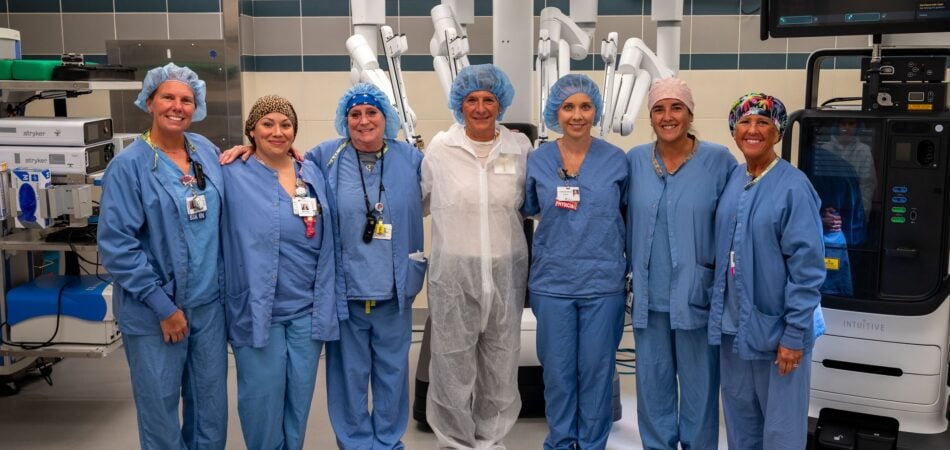
Oaklawn has used da Vinci technology for more than two decades. This spring, the hospital expanded its robotic surgery program to three da Vinci 5 systems, helping surgeons and staff work more efficiently while broadening access to minimally invasive procedures. It uses the technology in general surgery, gynecology and urology.
Less invasive surgery
Burtrum said Oaklawn’s long-running commitment to robotics has helped expand what surgeons can offer patients.
“Originally, it was used by urology and gynecology, and then as we saw the benefit coming through with general surgery cases, we started looking into that and getting trained,” Burtrum said. “Oaklawn has been great in helping us to have just the best technology that they have available out there.”
She said each upgrade has made a noticeable difference in the operating room, especially compared with traditional laparoscopic surgery.
“It is night and day,” Burtrum said. “Each upgrade is night and day in being able to perform procedures quicker. The difference between laparoscopic and robotic is also night and day, from your ability to see to your ability to do more robotically than you can laparoscopically. We’re seeing less conversion to open, which, if a patient has to be opened the old fashioned way with a big incision, can be really life-altering to them.”
For patients, that can mean smaller incisions, less pain and shorter recovery times.
Efficiency in the OR
Theresa Dawson, Oaklawn’s chief nursing officer, said the addition of a third da Vinci robot has improved flexibility for surgeons and staff. Instead of waiting for one robot to open up or reshuffling schedules around it, surgeons can plan cases more efficiently and Oaklawn can handle more procedures.
“It allows flexibility so that we don’t have to schedule around the use of another robot,” Dawson said. “So if I have an emergent case or an elective case, the surgeons don’t have to worry about rearranging their blocks or waiting for one to be done and moved into the next room so they can schedule ahead of time, and they can add additional so it’s additional cases and more convenience for the surgeons.”
Burtrum said Oaklawn’s investment goes beyond the robot itself. It also reflects training and staffing that allow patients to receive robotic surgery when it is the best option, even after hours.
“One of the nice things is the health equity of everybody being able to use the robot,” Burtrum said. “We are able to use the robot in the middle of the night. It doesn’t matter if a patient comes in at 1 a.m. if using the robot is what is best for them, everybody here is trained and we get it done robotically.”
For Byam, that local access is part of the benefit.
“I think we should be grateful that an independent hospital like Oaklawn has the da Vinci,” Byam said. “And we have locally skilled doctors to use it.”