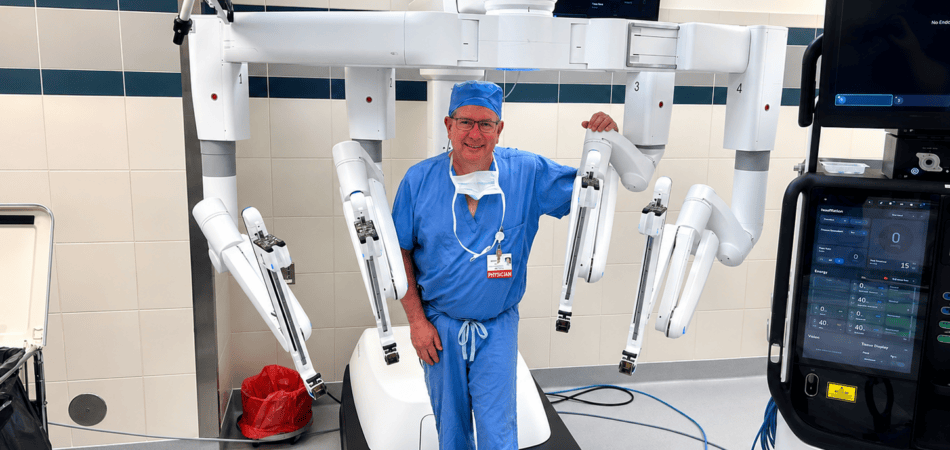
Q&A with Dr. Travis Terrell as he surpasses 1,000 da Vinci robotic cases
Q: You’ve now surpassed 1,000 Da Vinci robotic surgery cases. What does that milestone represent for you, your patients, and this community?
A: It’s been a long road. I first started doing robotic surgery in Battle Creek back in 2008, and I was one of the first surgeons in the community to do it. It’s been about 18 years now, so I’ve really seen the technology evolve over time.
I remember when we first introduced the robot at the hospital, we held a community forum and patients were asking, “How many cases have you done?” At that point, we hadn’t done any yet. So, to go from zero cases to more than 1,000 is pretty incredible.
Over the years, I’ve seen so many advancements with robotic surgery. Recovery has become much easier for patients, and we’re able to provide much better relief of their symptoms. It’s been rewarding to watch that progress firsthand.
Q: You were part of the steering committee that helped bring the first robot to Battle Creek Health System in 2008. Since then, how has robotic-assisted surgery improved the patient experience and recovery process?
A: What used to be the exception has really become the rule now. Minimally invasive procedures allow patients to recover much faster. They can get back to their regular lives more quickly and don’t have nearly as much disruption to their daily routines.
There’s typically a lot less pain, and honestly, I hardly ever have to fully open patients up anymore like we used to years ago. Recovery times are faster, and patients are able to get back to living productive, happy lives much sooner.
It’s probably one of the best advancements I’ve seen in my entire career.
I remember when the first robot arrived. Before we even had one, we practiced on these little rubber simulators and thought, “This would be pretty cool someday.” Since then, I’ve spent thousands of hours at the console, and now we’re about five generations into the technology. It’s kind of like cars — every new generation has more features and makes things easier and more efficient.

Q: What has it meant to you personally to provide this level of advanced surgical care close to home for our community?
A: The greatest satisfaction comes from seeing patients’ lives turn around. Many people come in dealing with pain or conditions that really affect their quality of life, and if you can fix that for them, they’re incredibly appreciative.
Seeing patients get back to living normal, productive lives again is what gives me the most satisfaction in my career.
Q: For patients who may feel nervous about robotic surgery, what would you want them to know?
A: There’s always going to be both positive and negative information out there, and sometimes people can get scared by things they read online.
My advice is: don’t spend too much time Googling or listening to scary stories. If you have questions or concerns, talk directly with your doctor. We’ll give you the real story and help you understand what’s best for your situation. You can also talk to other patients who’ve gone through the procedure themselves.
Q: When you reflect on the more than 1,000 patients you’ve treated using this technology, what makes you most proud?
A: What makes me most proud is seeing how much better people’s lives are afterward. I’m able to fix things much better than I could years ago when we only had traditional open surgery.
Being able to restore someone’s quality of life is the most rewarding part.
Q: Do you have any closing thoughts?
A: I’m proud to have been there when robotic surgery first started and to still be part of it today. I’ve seen it come such a long way.
When it first began, some people thought it was more of a gimmick or novelty. But I remember thinking, “Someday everybody is going to be doing this.” And sure enough, that’s exactly what happened where it’s appropriate and indicated for patients.